
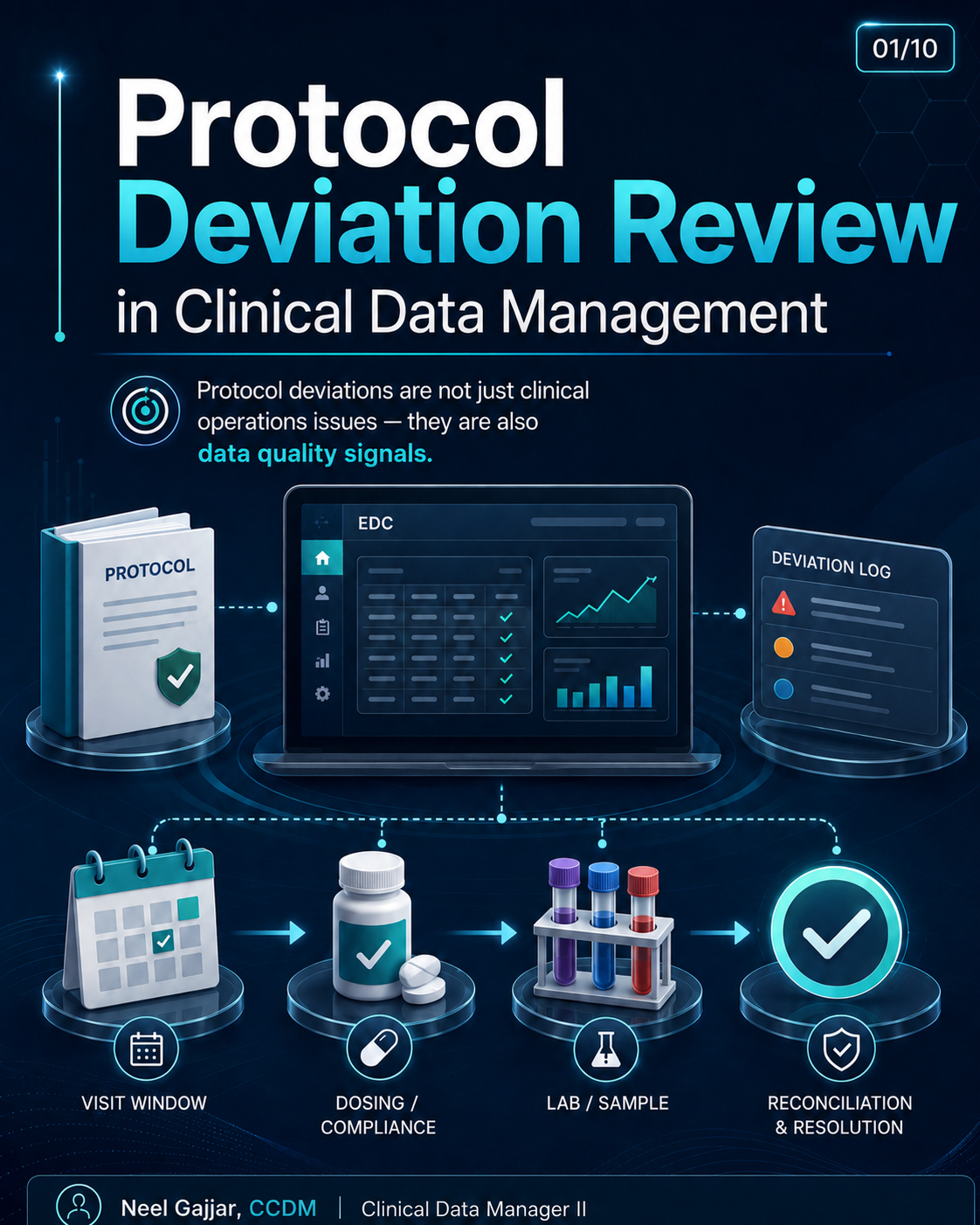
Introduction
Protocol deviations are not just study conduct issues - they are data quality signals.
When a protocol deviation occurs, it rarely affects only the site operations team. It ripples through the EDC, the deviation log, the CTMS, vendor records, safety listings, and endpoint datasets. For Clinical Data Managers, a protocol deviation is a trigger for active data review: checking whether the deviation is correctly reflected in the data, whether related records are consistent, and whether the impact is documented before the database is locked.
Protocol deviations are not just study conduct issues - they are also data quality signals.
Why Protocol Deviation Review Matters
Not all protocol deviations are equal. Under ICH GCP E6(R2) Section 4.5, deviations that may significantly affect participant safety, rights, or data integrity must be reported to the sponsor immediately. Protocol deviations are typically categorised as major (reportable, likely to impact analysis or safety) or minor (documented, managed internally). CDMs must understand the categorisation system in the study's protocol deviation SOP - because major deviations may trigger IRB/REB notification, regulatory reporting, or statistical exclusion decisions.
Six areas where deviations create data quality risk:
- Subject Eligibility - A deviation may affect whether a subject should remain in the study population, particularly for per-protocol analysis sets.
- Visit Windows - Out-of-window visits create timing inconsistencies against protocol-defined schedules, affecting time-sensitive assessments and PK parameters.
- Missing Assessments - Required tests, forms, or procedures may be incomplete and must be explained before lock.
- Dosing Compliance - Compliance deviations affect both safety analysis and exposure modelling in PK/PD studies.
- Endpoint and Safety Data - An unexplained deviation in an endpoint assessment without documented rationale creates ambiguity in the clinical study report.
- Database Lock Readiness - Unresolved deviation data issues block the lock and must be reconciled before a clean lock can be achieved.
What CDMs Do in Deviation Review
CDMs support protocol deviation review by ensuring deviation-related data is complete, consistent, and traceable. Six CDM responsibilities:
- Identify Data Inconsistencies - Detect mismatches or gaps in the EDC that may signal or relate to a protocol deviation.
- Review Related Records - Check visit dates, procedure dates, assessment statuses, and subject data for affected visits and forms.
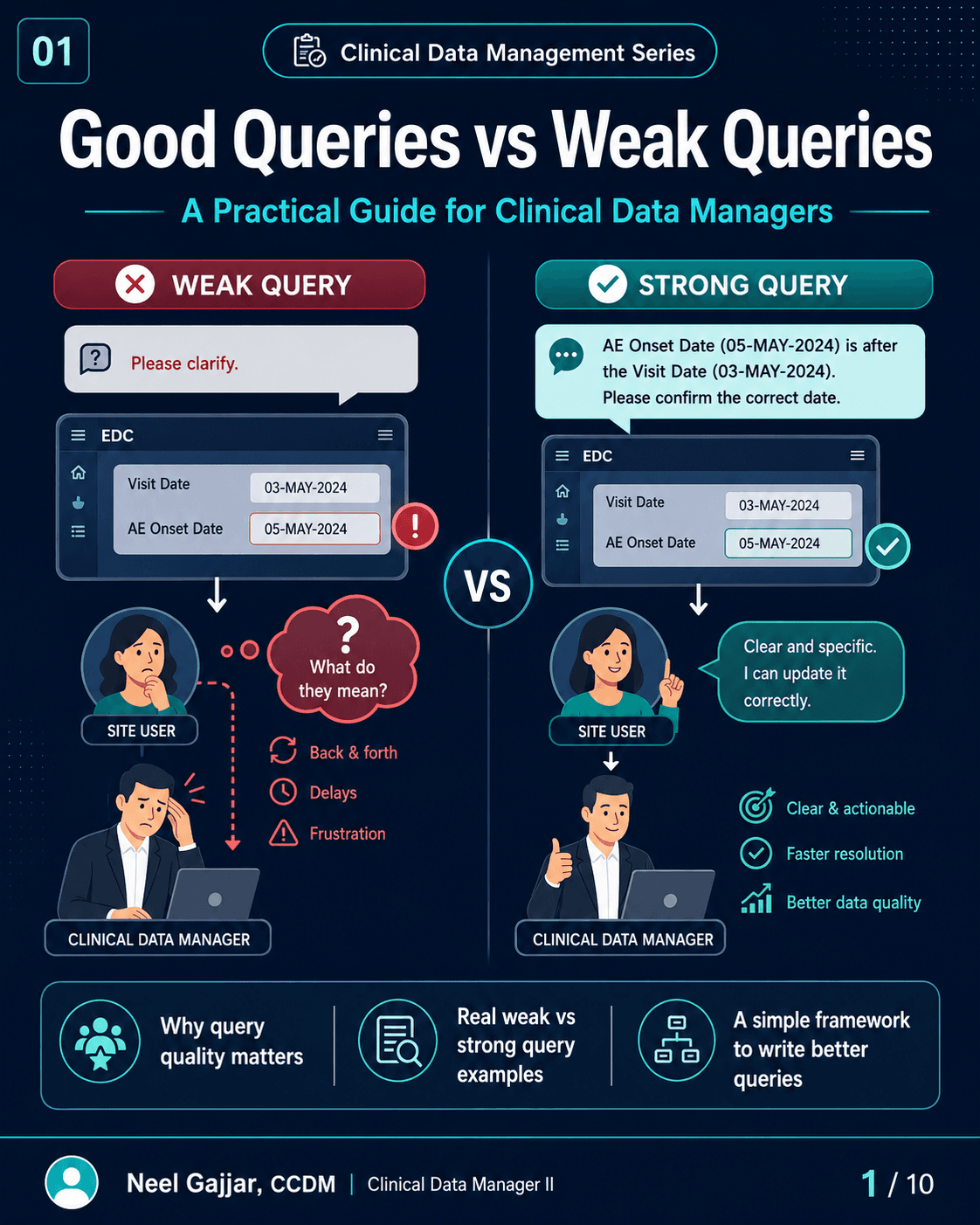
- Raise Clarification Queries - Request missing or unclear information from the site; deviation queries often require narrative explanation rather than simple correction.
- Support Reconciliation - Compare EDC data with the deviation log, CTMS, and vendor records. Reconciliation identifies where records agree, diverge, and where divergence needs to be explained.
- Document Traceability - Ensure the reason, impact, and outcome of the deviation are clearly documented. If the deviation affects analysable data, the record must allow analysts and reviewers to understand what happened and why.
- Prepare for Lock - Help resolve or explain outstanding deviation-related issues before the lock window opens. Every deviation affecting the data should have a documented disposition before lock.
Common Protocol Deviation Types: A CDM Lens
- Eligibility Deviation - Subject may not fully meet inclusion or exclusion criteria. Eligibility deviations are among the highest-risk categories - a subject enrolled in violation of a key criterion may need exclusion from the per-protocol population, directly affecting the primary endpoint analysis. CDM: confirm eligibility data in the EDC matches the screening log and deviation log; inform the statistical team of any eligibility deviation that may affect the analysis population.
- Visit Window Deviation - Visit performed outside protocol-defined timing. CDM: check the visit date against the protocol window, review related assessments, and confirm the reason is documented.
- Missing Assessment - Required test, form, or procedure not completed. CDM: confirm assessment status in the EDC, check whether a query has been raised and responded to, and verify a site explanation is on file.
- Dosing / Compliance Deviation - IP not taken or administered as required. CDM: compare dosing records with the expected protocol schedule, check compliance fields, and confirm the deviation is logged.
- Sample Collection Deviation - Lab, PK, or sample collected outside the protocol time window. CDM: check the collection timestamp, confirm the deviation log entry, and align vendor data with the EDC record.
- Procedure Mismatch - Wrong equipment or procedure used. CDM: confirm the procedure recorded in the EDC matches protocol requirements and the deviation is logged with an impact assessment.
Questions a Strong CDM Review Should Ask
- Is the deviation reflected correctly in the EDC or deviation log?
- Are visit dates, procedure dates, and assessment statuses consistent?
- Is the related data corrected, explained, or justified?
- Are queries needed to clarify the record?
- Does the issue affect endpoint, safety, or analysis data?
- Is the issue resolved or explained before database lock?
If the deviation affects the data, the data should explain it.
Data Sources to Reconcile
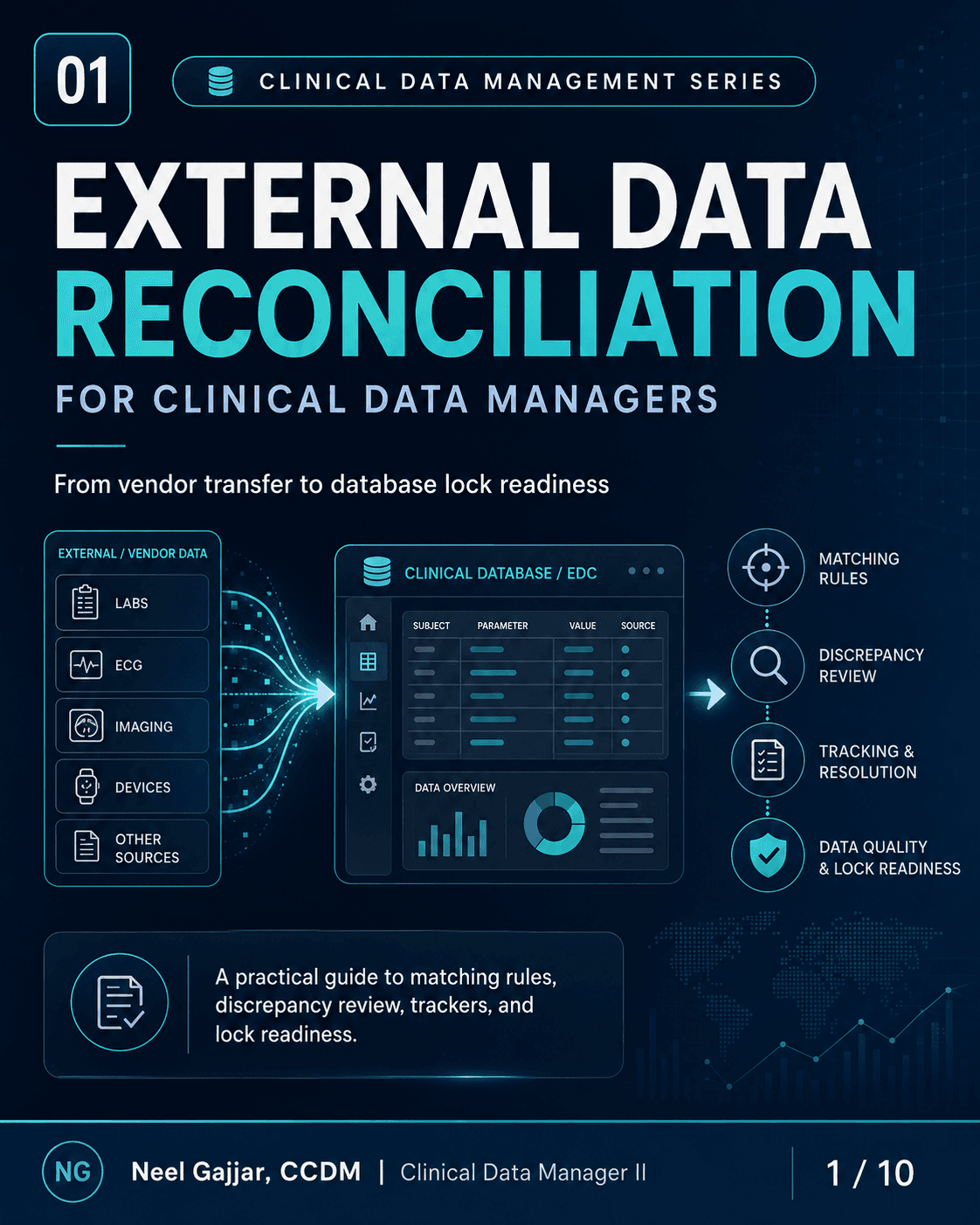
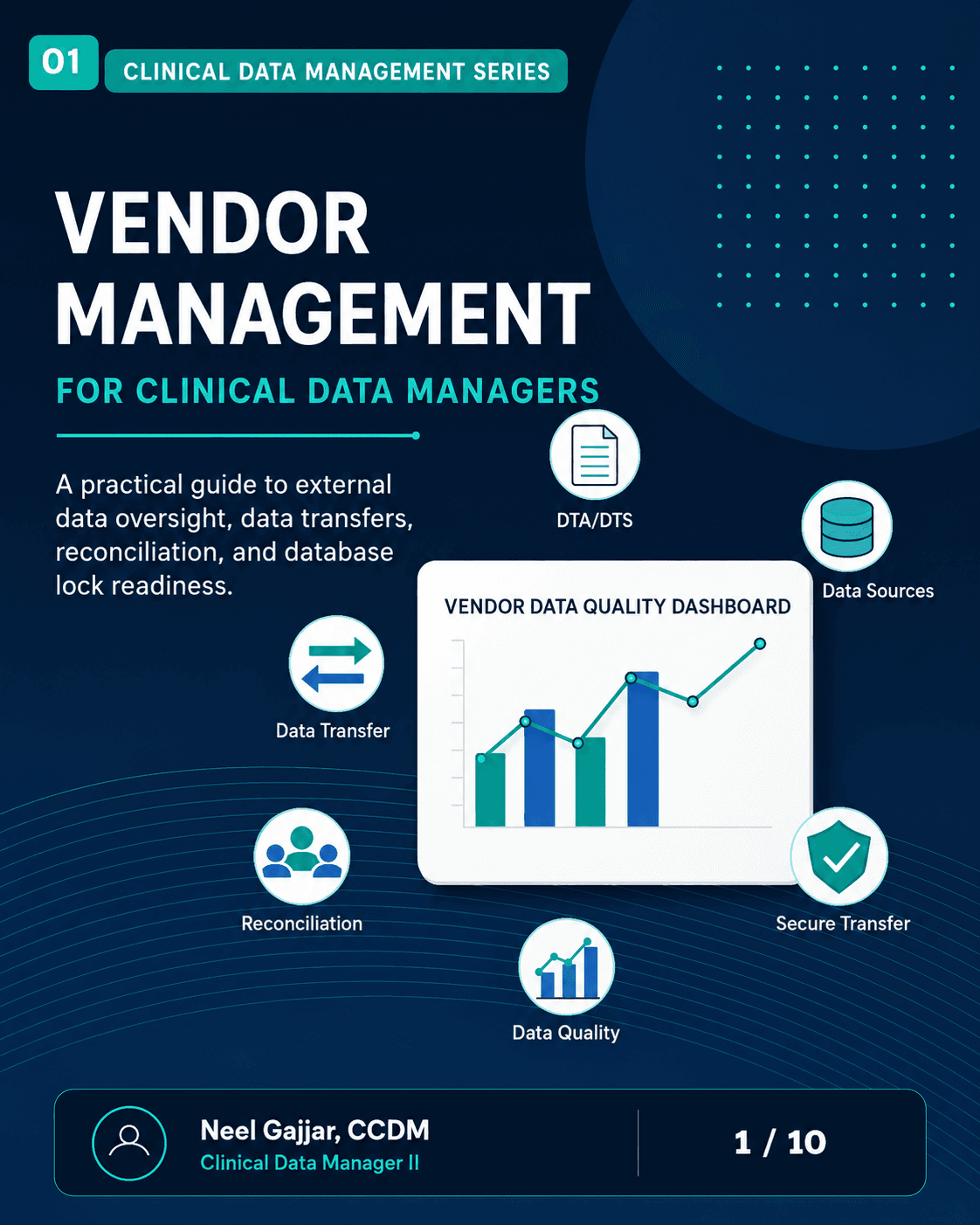
Protocol deviation review requires aligning records across multiple data sources. Goal: align the records, explain differences, and document the outcome.
| Data Source | What to Align |
|---|---|
| EDC | Visit dates, assessment statuses, procedure records, eligibility data |
| Deviation Log | Deviation classification, reason, impact, and disposition |
| CTMS / Monitoring Findings | CRA-identified issues, site visit findings, follow-up actions |
| Visit Schedule | Protocol-defined windows, scheduled vs. actual dates |
| Dosing / Compliance Records | IP dispensing, administration records, return records |
| Lab / PK / Vendor Data | Sample collection times, analysis results, vendor data transfers |
Practical Examples
Visit Window Example: Week 4 visit date is outside the protocol window. CDM review: confirm the visit date in the EDC, check the protocol window, review all assessments at that visit, and confirm the deviation is logged with a reason.
Missing Assessment Example: A required ECG was not completed at Week 8. CDM review: check the assessment status in the EDC, confirm a query has been raised and responded to, and verify the deviation is captured in the deviation log with impact documented.
Sample Timing Example: A PK sample collected 45 minutes outside the planned time range. CDM review: check the collection timestamp against the protocol window, confirm the deviation log entry, align vendor lab data with the EDC, and document the impact on PK analysis.
Consequences of Weak Deviation Review
Protocol deviation documentation quality is one of the most commonly cited findings in FDA 483 inspection observations. A deviation recorded in the deviation log but not explained in the EDC - or vice versa - is a documentation consistency finding. CDMs support inspection readiness by ensuring the EDC, deviation log, and supporting records tell the same story.
- Inconsistent EDC Record - Conflicting or incomplete data across forms and listings
- Unclear Endpoint Interpretation - Ambiguity leads to inconsistent derivations and conclusions
- Safety Review Gaps - Potential safety issues may be missed or under-evaluated
- Unresolved Analysis Questions - Open questions create uncertainty in results and CSR conclusions
- Audit Trail Confusion - Weak documentation makes it hard to reconstruct what happened and why
- Database Lock Delays - Outstanding issues block lock and delay study timelines
The CDM Protocol Deviation Review Workflow
- Identify - Spot the potential deviation or data inconsistency via EDC listings, data trends, and deviation logs
- Review - Pull the full subject record for the affected visit: dates, assessments, procedures, and related forms
- Reconcile - Compare across EDC, deviation log, CTMS, and vendor data; document where records agree and diverge
- Query / Clarify - Raise targeted queries requesting specific information; ensure queries are descriptive enough to get a meaningful response
- Document - Capture explanation, impact, disposition decision, and rationale for each deviation-related data issue
- Prepare for Lock - Confirm all deviation-related data issues are resolved or formally explained before the lock window opens
Final Takeaway
- Review the related data - Check dates, procedures, assessments, and supporting records for every deviation that touches analysable data
- Reconcile across sources - Align the EDC, deviation logs, CTMS findings, and vendor records; discrepancies must be explained
- Document a clear, traceable story - Make the impact and outcome understandable before lock
For CDMs, strong deviation review helps transform operational issues into understandable, analysable data.
This content is AI-assisted and expert-reviewed. All regulatory references are verified against ICH GCP E6(R2), FDA 21 CFR Part 312, and applicable clinical data management standards. Content is intended for clinical research professionals for educational and professional development purposes.
About the Author
Neel Gajjar
CCDM®Clinical Data Manager II
Clinical Data Manager specialising in EDC systems, CDISC standards, and GCP-compliant data governance. Creator of the Clinical Research Learning Hub — a platform built to make rigorous clinical research education accessible to every professional in the field.
Connect on LinkedInAll content is expert-written and SME-reviewed. Regulatory references are verified against current ICH GCP E6(R2), FDA, and EMA guidance.
Comments
Leave a comment