
Introduction
One of the most consistently confusing decisions in clinical trial operations is knowing what requires IRB/REB review and what should stay in the Trial Master File. Get it wrong in either direction: submitting everything creates administrative burden and delays; failing to submit a participant-impacting change is a protocol deviation.
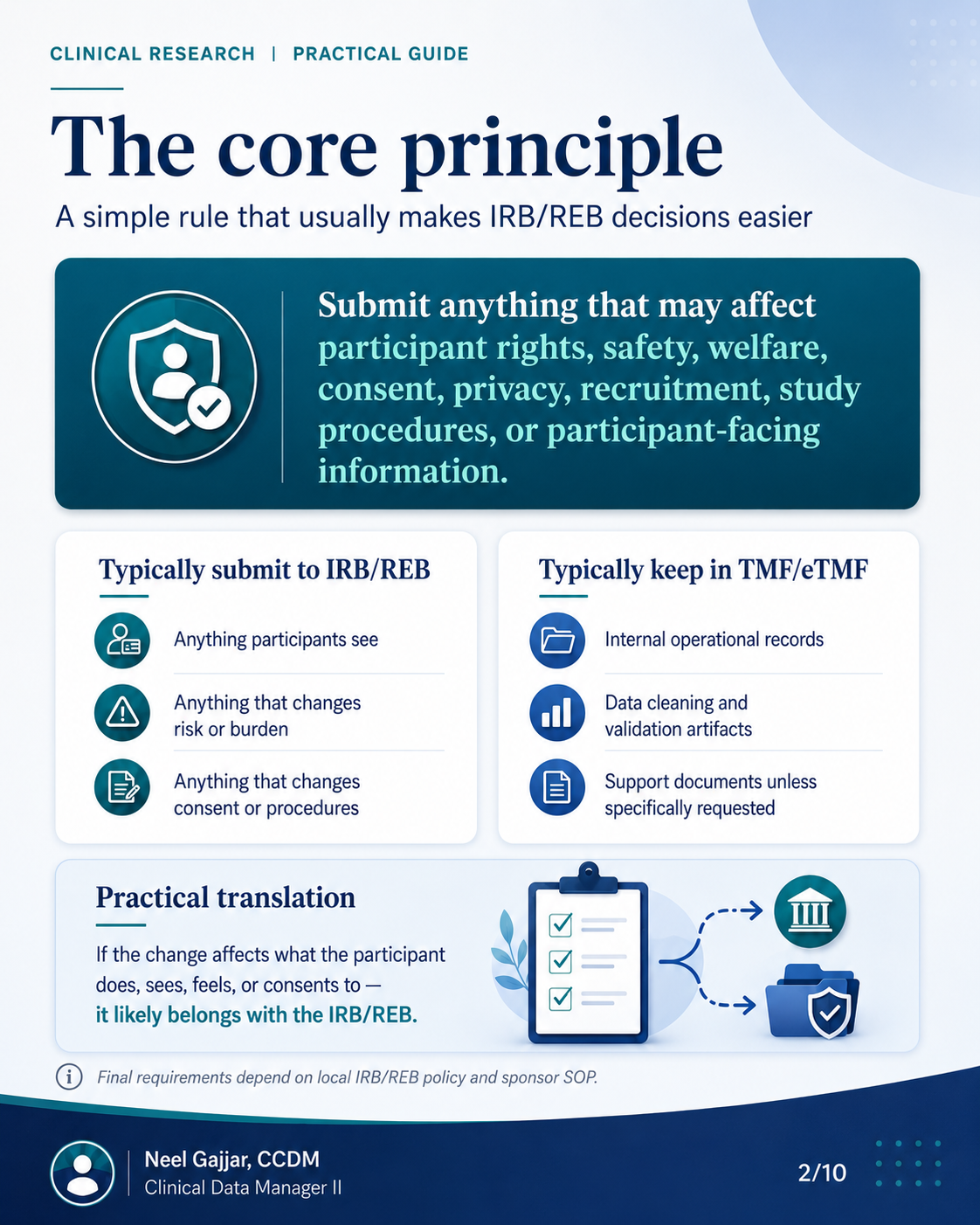
The Core Principle
Submit anything that may affect participant rights, safety, welfare, consent, privacy, recruitment, study procedures, or participant-facing information.
Typically submit to IRB/REB: Anything participants see · Anything that changes risk or burden · Anything that changes consent or procedures.
Typically keep in TMF/eTMF: Internal operational records · Data cleaning and validation artefacts · Support documents unless specifically requested.
If the change affects what the participant does, sees, feels, or consents to - it likely belongs with the IRB/REB.
The Initial Submission Package
| Category | Content |
|---|---|
| Protocol | Final protocol, synopsis, schedule of assessments |
| Consent Materials | ICF, assent, parental permission, re-consent language |
| Participant-Facing Content | Recruitment ads, flyers, phone/email scripts, study-specific reminders |
| Investigational Product/Safety Information | Investigator's Brochure, product monograph, device information |
| Questionnaires/ePRO | Diaries, VAS, PRO/eCOA forms, participant instructions |
| Site/Investigator Documents | PI CV, licence, GCP training, site documents required by local REB |
| Compensation | Payment schedule, reimbursement, gift cards, travel support |
Participant-Facing Materials: The Key Category
If participants see it, it often needs IRB/REB review. This category is broader than most teams initially realise:
- Recruitment - Flyers, ads, social media copy, email and phone scripts
- Consent - ICF, assent, parental permission, re-consent language - every version
- Instructions - Dosing guides, visit instructions, device/app instructions
- Questionnaires - Diaries, ePRO screens, app screens, alerts, reminders, VAS surveys
- Privacy/Data Sharing - Anything communicating data sharing or confidentiality terms to participants
- Payment - Compensation, reimbursement, gift cards, travel support
CDM reminder: If an ePRO or app content is shown to the participant, it is participant-facing content. A common error is assuming ePRO or eConsent platform changes require only IT sign-off. Any change to participant-displayed content - including reminder text, question wording, or instructions - must be assessed for IRB/REB review, regardless of the technical delivery mechanism.
Amendments and Change Control
Submit before implementation when the change affects participant experience. Amendment triggers include:
- Protocol amendment - new visit, procedure, revised schedule, or assessment timing
- Consent update - new risk, new compensation, or revised wording
- Participant material change - new diary, revised recruitment, or changed instructions
- Eligibility criteria changes
- Safety monitoring updates - new IB, new follow-up, new stopping rule
- Privacy/data sharing changes - new vendor, transfer method, or storage model
- PI/site changes - new PI, site activation or closure
The exception is an urgent safety measure - under ICH GCP E6(R2) Section 4.5.2, a deviation to protect participants from immediate harm may be implemented first, then reported to the IRB/sponsor as soon as possible. For US IND studies under 21 CFR 312.66, sponsors must promptly report to IRBs any adverse experience that may affect participant willingness to continue or require protocol modification.
Safety and Reportable Events
| Event | Timing |
|---|---|
| Unexpected serious risk or new safety signal | Usually report promptly |
| New safety information | Usually report promptly |
| Major protocol deviation (participant safety/data integrity affected) | Especially report promptly |
| Immediate action to eliminate urgent hazard | Implement first, then report promptly |
| Study suspension or termination | Report per local requirements |
| Minor operational issue | Usually document internally |
Continuing Review and Closure
- Annual/continuing review - Enrolment status, participant status, safety reports, deviations, study progress
- Early termination or suspension - Reason, participant status, sponsor/site actions
- Study closure report - Completion or withdrawal summary, unresolved safety items, closure confirmation
Usually Maintained Internally (TMF/eTMF)
Keep in TMF/eTMF: Data Management Plan · Data Validation Plan · Edit Check Specification · Data Entry Instructions · EDC testing/UAT evidence · Query trackers · Monitoring plans and reports · Training logs and delegation records.
Submit if participant-impacting: Privacy/data sharing language shown to participants · Participant-facing instructions · Consent-impacting vendor changes · Support documentation requested by IRB/REB.
CDM/EDC Boundary Examples
| More Likely to Require IRB/REB Review | Usually Internal |
|---|---|
| New participant diary or ePRO form | Variable name or label change (not shown to participants) |
| Revised wording shown in app screens or reminders | Edit check wording shown only to site staff |
| New at-home dosing or collection instructions | Form layout change with no participant impact |
| Visit schedule or assessment timing change | Query wording or data cleaning logic |
| Change in privacy or data transfer language shown to participants | DMP/DVP/validation artefact updates |
If an EDC or ePRO change affects participant experience, consent, or privacy - it may require IRB/REB review.
Fast Decision Rule
| Question | Answer |
|---|---|
| Does it affect participant safety or risk? | → Submit |
| Does it affect consent or what participants are told? | → Submit |
| Does it affect study procedures, visits, dosing, or assessments? | → Submit |
| Does it affect privacy, confidentiality, or data sharing? | → Submit |
| Is it only internal CDM/EDC/validation documentation? | → Usually keep in TMF/eTMF |
Bottom line: Submit participant-impacting content. When uncertain, check your REB guidance, protocol, sponsor SOP, approval conditions, and local IRB/REB policy.
About the Author
Neel Gajjar
CCDM®Clinical Data Manager II
Clinical Data Manager specialising in EDC systems, CDISC standards, and GCP-compliant data governance. Creator of the Clinical Research Learning Hub — a platform built to make rigorous clinical research education accessible to every professional in the field.
Connect on LinkedInAll content is expert-written and SME-reviewed. Regulatory references are verified against current ICH GCP E6(R2), FDA, and EMA guidance.
Comments
Leave a comment