
Introduction
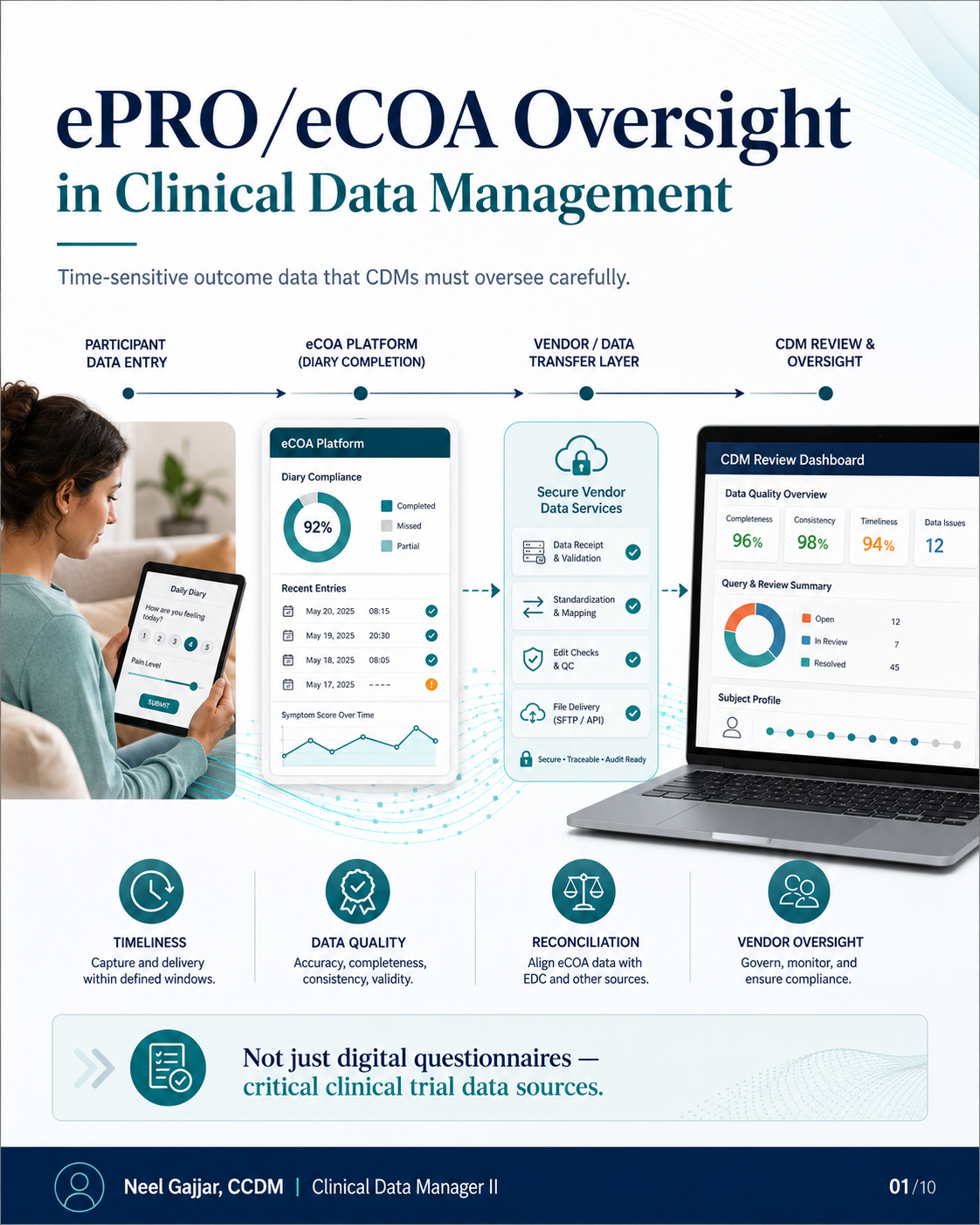
ePRO and eCOA data are time-sensitive outcome data that sit at the core of endpoint integrity for many clinical trials. Missing a collection window is not an administrative inconvenience - for some endpoints, data collected outside the protocol-defined window may be irrecoverable or unusable for analysis.
Not just digital questionnaires - critical clinical trial data sources.
CDM oversight spans four layers: participant data entry, platform and query completion, vendor and data transfer management, and CDM review and oversight. All four must be actively managed throughout the study.
What Is eCOA? Understanding the Full Taxonomy
eCOA (electronic Clinical Outcome Assessment) is the broader category encompassing all forms of electronic outcome measurement. ePRO is one type within it - but not all eCOA data is participant-reported.
TypeFull NameWho Reports ItePROElectronic Patient-Reported OutcomeReported directly by the participanteClinROElectronic Clinician-Reported OutcomeReported by the clinicianeObsROElectronic Observer-Reported OutcomeReported by an observer or caregiverePerfOElectronic Performance OutcomeCaptured through a performance-based assessment
Different eCOA types have different source data expectations, audit trail requirements, and reconciliation logic with EDC.
Why ePRO/eCOA Matters: High-Value Data with High Oversight Needs
ePRO/eCOA data has three timing states: Window Open (participant eligible to complete) → Completed (entry captured on time) → Window Closed (missed).
Whether out-of-window data is excluded from analysis depends on the SAP and analysis set definitions - CDMs should confirm with the statistician which windows are analysis-critical before the study opens, not at lock. ePRO data collected outside a hard window may be permanently excluded from the primary endpoint analysis.
Six categories of ePRO/eCOA data: Patient-reported symptoms · Daily diaries · Quality-of-life assessments · Questionnaire scores · Endpoint or supportive data · Compliance tracking.
CDM Oversight Starts Before Go-Live
Five setup areas where CDM oversight must begin at protocol review:
Protocol and SOA - Questionnaire licensing, version control, visit/diary/completion windows, language and country requirements
eCOA Platform - Reminder and escalation logic, device/BYOD access, timezone configuration
Mobile Device - Device/BYOD requirements documented and tested; timezone verified per site country
Vendor Transfer - Transfer frequency, format, and expected fields in DTA/DTS; scoring/output specification confirmed with vendor and statistician
EDC and Database Readiness - UAT evidence documented; scoring/output specification verified; reconciliation plan in place
A strong setup reduces missing data, reconciliation issues, and database lock delays.
UAT Should Test Real Study Scenarios
UAT must prove the system handles real study behaviour - including failure modes. Eight scenarios that must be included:
Normal Completion - Complete a diary entry; verify all required fields captured
Missed Diary Window - Complete entry early or too late; verify system flags or rejects
Wrong Visit Assignment - Assign to wrong visit; verify error and validation logic
Language/Country Assignment - Verify correct questionnaire version assigned per country/language
Reminder Logic - Verify reminder timing, frequency, and escalation conditions
Timestamp Handling - Verify time-zone and DST rules apply correctly
Data Transfer Output - Verify transferred output includes expected fields and structure
Score/Output Generation - Verify scoring rules produce expected derived output
UAT should prove real study behaviour, not only happy-path entry.
Key Data Checks: Asking the Right Questions
Completion rates alone do not equal data quality. Strong ePRO/eCOA review asks seven questions:
Who completed it? - Confirm respondent identity matches target subject
When was it completed? - Verify date/time against visit and protocol-defined windows
Which version was used? - Ensure correct deployment version and translations applied
Was it complete? - Check required items, skipped logic, and endpoint rate
Was the audit trail intact? - Validate timestamps and acknowledgements are present
Was it transferred correctly? - Confirm successful transfer across datasets and timelines
Was it reconciled? - Confirm ePRO/eCOA data with EDC for consistency
Completion alone does not equal data quality.
What CDMs Should Review During the Study
ePRO/eCOA review should happen while action is still possible. CDM monitoring should cover:
Expected vs. completed questionnaires by subject, visit, and site
Duplicate or unexpected entries outside expected parameters
Missing diary entries within the collection window
Completion date/time timeliness - out-of-window entries flagged and dispositioned
Visit window alignment - entries mapped to correct visit
Subject ID and visit mapping correctness in EDC
Audit trail and timestamps completeness
Vendor transfer status - received on schedule, completeness tracked
Reconciliation with EDC as applicable
Score and derived output availability
Common ePRO/eCOA Issues CDMs Should Watch For
Missing diary entries - expected entries not completed; may indicate device, reminder, or compliance issues
Out-of-window completion - entry too early or too late; may be excluded from analysis per SAP
Device or access issues - participant could not access platform; device, login, or connectivity failure
Wrong language/version - incorrect questionnaire version assigned; configuration error requiring immediate deviation documentation
Timestamp mismatch - timezone or date/time inconsistency between ePRO platform and EDC
Incorrect subject status handling - discontinued subjects still receiving forms, or active subjects whose forms have stopped
Vendor transfer delay - data not received on schedule; impacts reconciliation and database lock readiness
Small setup or timing issues can create major downstream data quality problems.
Vendor Data Flow: From Entry to the Clinical Database
Data moves through five stages from participant entry to analysis dataset:
Participant/Clinician/Observer Entry - Data captured in real time; responses stored, timestamps generated
eCOA Platform and Scoring - Scoring rules applied; derived output generated per DTS
Vendor QC and Data Transfer - Transfer per DTA/DTS; CDM validates transfer frequency, completeness, and specification compliance
CDM Transfer QC - Validate incoming files against expected structure, fields, scoring output, and completeness
EDC Reconciliation and Analysis Dataset - Reconcile ePRO/eCOA with EDC; confirm no open queries or data gaps before lock
CDMs must understand both the data collection workflow and the data transfer workflow.
Final Takeaway: Seven Principles for ePRO/eCOA Oversight
Strong setup - Define clear workflows, edit checks, and scoring logic before study opens
Realistic UAT - Test all scenarios, integrations, and trigger logic
Ongoing compliance review - Monitor data quality, timeliness, and queries during the study
Vendor transfer oversight - Validate transfers and DTA/DTS compliance with every receipt
Scoring output review - Validate calculated scores against manual calculations for a sample of records; for FDA submission endpoints, confirm COA qualification status early (FDA CDER COA Qualification Program)
EDC reconciliation - Reconcile regularly; no open data gaps before lock
Final readiness means database lock - All queries resolved, timeliness met, no open data gaps
Good ePRO/eCOA oversight protects data completeness, timing accuracy, endpoint quality, and database lock readiness. ePRO/eCOA data is time-sensitive and should not be reviewed only at the end.
About the Author
Neel Gajjar
CCDM®Clinical Data Manager II
Clinical Data Manager specialising in EDC systems, CDISC standards, and GCP-compliant data governance. Creator of the Clinical Research Learning Hub — a platform built to make rigorous clinical research education accessible to every professional in the field.
Connect on LinkedInAll content is expert-written and SME-reviewed. Regulatory references are verified against current ICH GCP E6(R2), FDA, and EMA guidance.
Comments
Leave a comment